Modern B2B enterprises manage thousands of prospective accounts simultaneously. Sorting through these accounts manually creates immense operational strain. Traditional tiering methods rely on static criteria like company size or geographic location. These rigid models fail to capture dynamic behavioral signals. They also overlook real-time intent shifts, causing sales teams to pursue cold leads while hot opportunities expire.
To eliminate this guesswork, engineering teams build predictive grading models directly inside their CRM platforms. Salesforce Einstein AI Integration transforms traditional databases into proactive scoring engines. By evaluating historical data patterns and live interaction metrics, the system calculates precise propensity scores for every account.
Technical Foundations of Account Grading
Predictive scoring requires a comprehensive data architecture to function accurately. Einstein AI does not guess account value. Instead, it extracts statistical patterns from across your enterprise database.
1. The Standard Account Data Model
The grading engine relies on core Salesforce architectural objects to assess account health. The system maps customer attributes across three distinct layers:
- Firmographic Tables: Fields within the Account object, including annual revenue, employee count, and industry code.
- Engagement Logs: Related lists containing history from the Task, EmailMessage, and Event objects.
- Commercial Metrics: Financial indicators located inside the Opportunity and Order objects.
Einstein analyzes how these objects interact over time. For example, the engine looks at how many technical support cases an account logs before purchasing a product upgrade.
2. Integrating the Data Foundation
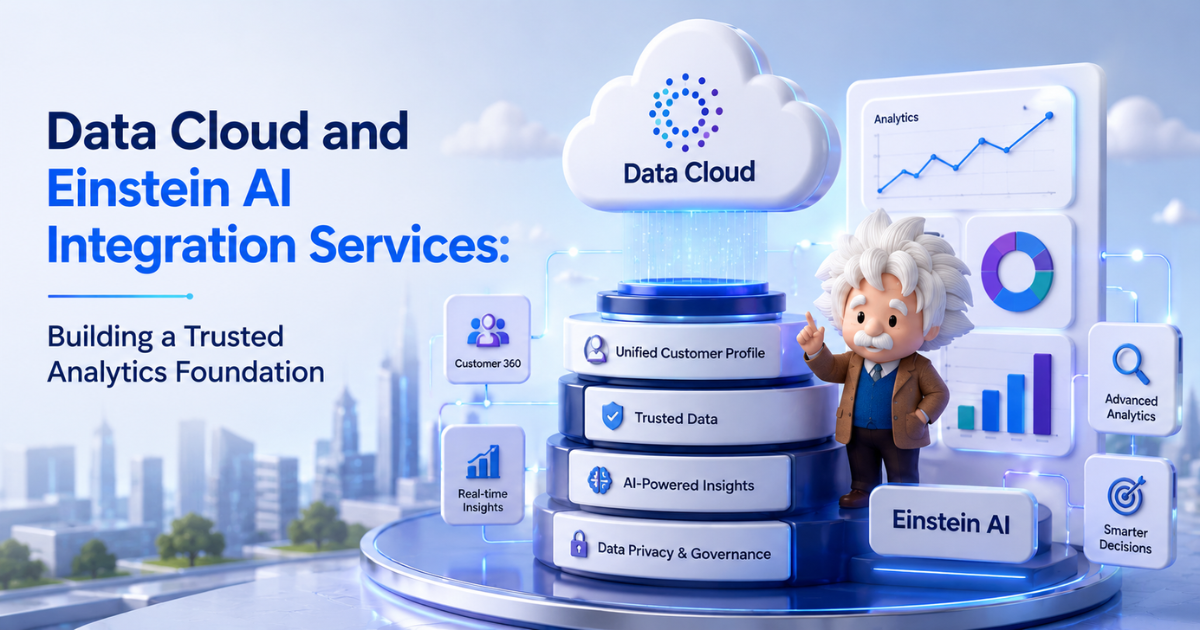
To feed the machine learning models, developers must first unify their business data. Salesforce Einstein AI Integration Services use Salesforce Data Cloud to ingest high-volume external data streams without causing system lag.
Data Cloud normalizes unstructured information, like website click histories and product usage logs. It prepares this information for the algorithmic grading layer, ensuring high data quality before calculations begin.
Configuring Einstein Prediction Builder
Developers use Einstein Prediction Builder to create custom account scoring models tailored to specific business goals. This tool allows companies to predict custom outcomes, such as the likelihood of an account renewing a contract.
1. Defining the Prediction Goal
The technical team must first state the exact business question they want the AI to answer. To build an account renewal predictor, developers set up two primary record sets within the tool:
- The Training Set: Historical account records where the renewal outcome is already known. This includes records marked as “Renewed” or “Cancelled.”
- The Prediction Set: Active account records where the renewal outcome remains unknown.
2. Selecting Model Predictors
Developers choose which specific fields the algorithm should analyze. Including irrelevant fields can degrade model accuracy. The system allows engineers to exclude problematic fields, such as text comment blocks that contain random notes.
This Apex logic reads the score generated by the Einstein engine. It automatically reassigns account priority status fields whenever a scoring change occurs, ensuring sales teams see accurate data instantly.
The Einstein Trust Layer and Security Architecture
Deploying artificial intelligence within global enterprises requires strict compliance with international data privacy laws. Companies must secure sensitive customer data from exposure.
1. Protecting Sensitive Data Fields
The Einstein Trust Layer acts as a secure buffer between corporate data extensions and machine learning algorithms. It prevents confidential data from leaking outside secure zones during model evaluation.
- Data Masking: The platform replaces private data, like personal phone numbers or credit card sequences, with anonymous tokens before processing.
- Toxicity Scoring: The system monitors incoming text fields to flag and block profane or non-compliant language automatically.
- Zero-Data Retention Policies: External large language models cannot save corporate CRM payloads for public model training purposes.
2. Enforcing Role-Based Access Control
Administrators maintain data security by applying field-level security rules to the generated score fields. A field service representative may see a basic account tier badge, while a financial analyst accesses the raw percentage metrics behind the score. This role-based configuration prevents internal data misuse.
Quantifiable Impact and Operational Metrics
Upgrading from manual tiering rules to automated predictive scoring engines delivers measurable improvements in operational performance.
1. Boosting Conversion Rates
According to industrial Salesforce implementation studies, companies deploying automated lead and account scoring models achieve a 20% to 25% average increase in overall conversion rates.
The predictive engine eliminates the time representatives waste calling low-intent prospects. Instead, it guides teams to focus on buyers showing clear purchase signals.
2. Minimizing Churn Costs
Predictive models identify at-risk customers long before they cancel services. Early warnings allow account managers to intervene proactively, reducing annual customer churn rates by up to 15%.
The tables below display technical data contrasting static grading structures with automated Einstein architectures:
| Account Management Aspect | Static Tiering Framework | Einstein Predictive Architecture |
| Data Refresh Speed | Monthly or Quarterly Batches | Continuous Real-Time Updates |
| Analysis Parameters | 3 to 5 Static Fields | Over 50 Dynamic Interaction Signals |
| Scoring Consistency | High Subjective Bias | Algorithmic Statistical Baseline |
| Workflow Triggering | Manual Review Dependencies | Automated Apex and Flow Triggers |
Step-by-Step Deployment Methodology
Implementing a predictive scoring framework requires following an orderly engineering sequence. This process ensures the system aligns correctly with historical business metrics.
1. Data Sufficiency Verification
Before building a model, developers must confirm they have enough historical records. Einstein Prediction Builder requires at least 400 historical records with known outcomes to establish a statistical baseline.
2. Sandbox Model Creation
Engineers build and test the predictive model in an isolated sandbox environment first. This step prevents experimental code from disrupting live production workflows or modifying active account scores.
3. Reviewing the Scorecard Metrics
Once the training cycle completes, Einstein generates a detailed scorecard. This report includes a critical metric called the Prediction Quality score, rated from 0 to 100:
[Prediction Quality Scorecard]
0 – 49: Low Quality (Too few records or bad data fields)
50 – 84: High Quality (Stable, dependable prediction model)
85 – 100: Suspect Quality (Likely data leakage or duplicate fields)
If a model scores a 98, developers investigate if the input fields include future data points that skew the mathematical results.
4. Deploying to Live Production
After validating model accuracy, administrators deploy the configuration to the production environment. The platform begins calculating scores for all active records, writing the values to the designated custom fields.
Resolving Common Technical Bottlenecks
Enterprise architecture teams often face technical roadblocks during initial machine learning integration cycles.
1. Handling Data Leakage Failures
Data leakage occurs when target outcomes accidentally influence input fields during the model training phase. For example, including an Invoice_Number field to predict if an account will buy a product creates an artificial correlation. Only closed deals receive invoice numbers, so the model breaks when evaluating new prospects.
Mitigation Strategy: Engineers must audit all predictor fields in Einstein Studio. They must exclude fields that users update only after the target event occurs, ensuring the algorithm judges accounts purely on pre-purchase signals.
2. Mitigating Data Bias Deviations
If an organization historically ignored specific geographic regions, the machine learning model will flag those regions as low-value zones. The system simply repeats past human biases instead of finding genuine market opportunities.
Mitigation Strategy: Data teams should use Einstein Data Insights to audit their training pools. They must balance the training data across diverse customer groups to ensure the algorithm evaluates new markets fairly.
Long-Term Model Management
Maintaining scoring accuracy over multi-year business cycles requires continuous maintenance and structured monitoring.
1. Tracking Performance Drift
Consumer behaviors shift over time due to macroeconomic changes and new product releases. A model built in 2024 may lose its predictive accuracy by 2026. This decay is known as model drift.
Developers combat drift by setting up automated alerts inside Tableau CRM. These alerts notify data administrators if the model’s accuracy drops below established operational thresholds, signaling that it is time for a system refresh.
2. Conducting Model Retraining Cycles
Administrators schedule automated retraining routines every six months. The platform ingests the newest batch of closed customer accounts, updating field weight values to match recent market changes. This ongoing maintenance keeps account grades accurate and reliable.
Technical Summary of Account Grading
Replacing manual tiering matrices with automated predictive engines ensures sales teams spend their time on high-value targets. Salesforce Salesforce Einstein AI Integration provides the structural framework needed to analyze complex interaction logs and convert raw metrics into actionable scores.
By utilizing Data Cloud ingestion, precise prediction builder definitions, and strict security layer safeguards, companies can deploy automated account grading systems safely. This modern technical architecture eliminates administrative delays, improves forecast accuracy, and helps global businesses maximize their total CRM platform return on investment.
Conclusion
Relying on manual account scoring models exposes modern B2B organizations to severe resource misallocation risks. Disorganized data tracking slows down sales cycles and allows high-value prospects to drop out of the pipeline. Companies must treat predictive analytics as a foundational piece of their commercial framework rather than an optional IT project.
Deploying algorithmic scoring models through professional Salesforce Einstein AI Integration Services provides the governance model needed to manage corporate pipeline data effectively. This architecture pattern optimizes daily staff focus while protecting sensitive customer data records. By establishing clear data modeling standards, automated security guardrails, and ongoing retraining workflows, modern global enterprises eliminate operational friction and secure a sustainable competitive advantage.