Enterprise intelligence relies entirely on the quality of underlying corporate data. Many artificial intelligence initiatives fall short because companies feed advanced algorithms isolated, fragmented data. Studies from the IBM Institute for Business Value reveal that only 33% of corporate AI initiatives currently meet internal ROI targets. Furthermore, 53% of executives cite poor data availability and quality as the primary barrier to adoption.
To overcome these data gaps, companies must integrate real-time data engines with contextual machine learning repositories. Implementing Salesforce Einstein AI Integration Services allows teams to unite isolated databases, run secure analytical models, and protect consumer privacy. Businesses increasingly depend on Salesforce Einstein AI Integration Services to create trusted, scalable, and intelligent analytics ecosystems.
Architectural Blueprint of Data Cloud and Einstein AI
A high-performance predictive environment requires a real-time data architecture. The integration uses a multi-layered structure to ingest data, harmonize records, and run predictive engines safely. Organizations implementing Salesforce Einstein AI Integration Services benefit from a centralized architecture that improves data consistency and predictive performance.
1. Ingestion and Virtualization Layer
Data Cloud serves as the single ingestion hub for all external enterprise systems. The system processes massive data volumes efficiently. Market data shows that Data Cloud stores more than 22 trillion data points. It handles approximately 7 trillion inbound records per quarter.
Developers connect external storage architectures like Snowflake, Databricks, or Amazon Web Services through Zero Copy virtualization. This technical approach activates data inside Salesforce without executing slow, expensive physical replication processes. Many enterprises adopt Salesforce Einstein AI Integration Services because this architecture reduces latency and simplifies access to enterprise-wide intelligence.
2. Data Harmonization Layer
Raw inbound data from a website log does not naturally match a standard CRM contact record. Data Cloud uses Customer 360 Information Models to map disparate identities.
The system applies specific match rules to combine duplicate entries into one golden corporate profile. This unified profile provides the essential groundwork for Salesforce Einstein AI Integration Services and helps predictive models generate more accurate business recommendations.
Technical Mechanics of Vector Grounding
Large language models require precise enterprise context to avoid hallucination failures. Vector grounding acts as the technical bridge between raw user prompts and unified database objects. Businesses using Salesforce Einstein AI Integration Services can improve contextual intelligence and reduce inaccurate outputs.
1. The Vector Indexing Process
Data Cloud indexes both structured CRM data fields and unstructured corporate assets like PDF product manuals. The system converts text records into mathematical vector coordinates.
When a customer or representative submits a conversational prompt, the platform transforms the query into a vector representation. It executes a mathematical vector proximity search inside Data Cloud to pull matching reference records within milliseconds. This process makes Salesforce Einstein AI Integration Services highly valuable for enterprise-scale conversational analytics.
Secure Data Lifecycle via the Einstein Trust Layer
Connecting enterprise databases to external machine learning frameworks presents serious security challenges. Advanced Salesforce Einstein AI Integration Services use a dedicated security middleware pipeline to protect critical corporate assets.
1. PII Data Masking Mechanics
The platform scans out-of-the-box system parameters and custom text fields for sensitive records before sending data payloads to external artificial intelligence services.
- Identification: The masking gateway flags phone numbers, credit card combinations, and social security strings.
- Substitution: The engine replaces sensitive text strings with randomized cryptographic anonymous tokens.
- Transmission: The external foundation model receives only anonymized metadata arrays to perform its synthesis tasks.
2. The Zero-Data Retention Mandate
Enterprise compliance guidelines require strict isolation boundaries. The secure gateway enforces a strict zero-data retention policy with third-party model providers.
The external vendor cannot save inbound prompts, store corporate transactional metadata, or use enterprise context logs to train future public machine learning models. The system drops the data frame immediately after processing the response payload. This security model makes Salesforce Einstein AI Integration Services a trusted choice for regulated industries.
Configuring Einstein Prediction Tools
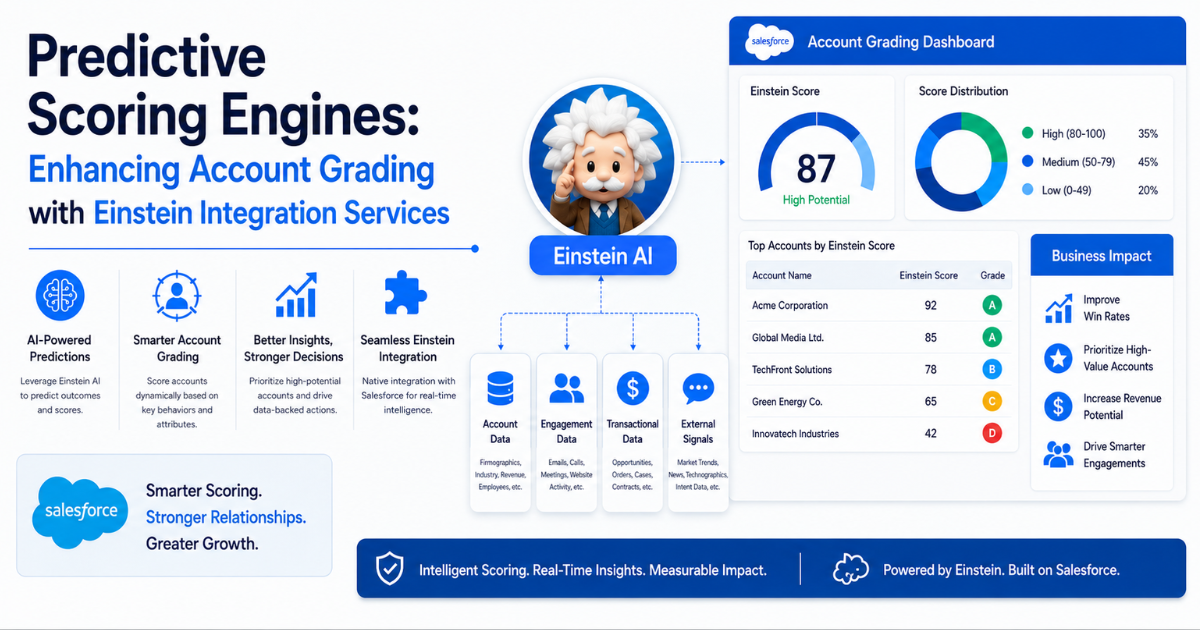
Building predictive dashboards requires structured analytics schemas. Developers use low-code and pro-code features to construct reliable scoring models with Salesforce Einstein AI Integration.
1. Einstein Prediction Builder Setup
Prediction Builder helps teams forecast business metrics, such as a client’s likelihood to cancel a subscription service. Developers configure these tools by selecting specific target data arrays.
2. Einstein Discovery Model Implementation
Einstein Discovery analyzes deep historic records inside Data Cloud to locate hidden operational correlations. Companies leveraging Salesforce Einstein AI Integration Services can uncover patterns that improve forecasting accuracy and operational planning.
Summary of Analytics Infrastructure
Deploying smart enterprise workflows requires an integrated approach to data organization and system validation. Comprehensive Salesforce Einstein AI Integration Services help businesses connect scattered backend systems, protect personal data records, and deliver actionable insights across the enterprise. Using an optimized data layer allows companies to minimize compliance risks and build a scalable, trusted analytics foundation. As enterprise AI adoption grows, Salesforce Einstein AI Integration Services continue to play a major role in building secure and reliable analytics environments.ies to minimize compliance risks and build a scalable, trusted analytics foundation.ed analytics foundation.