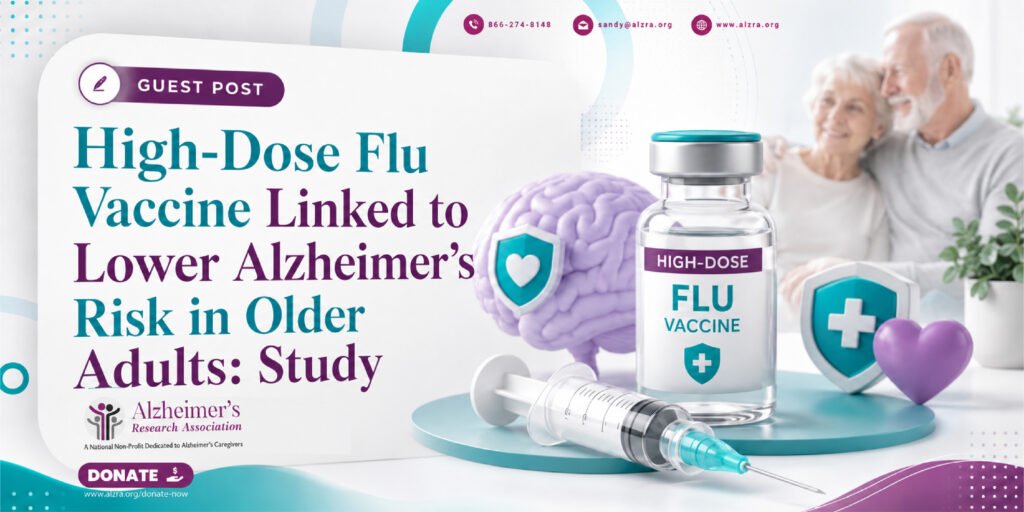
Researchers have been investigating already-in-use vaccines to see if they can help reduce the risk of Alzheimer’s disease and other forms of dementia. The influenza vaccine is one such vaccine that may help reduce a person’s risk of dementia, according to previous studies. Recently, a new study has discovered that older persons who receive a high-dose influenza vaccine may have a lower risk of developing Alzheimer’s than those who receive a standard vaccine dose.
What if a seasonal vaccine could offer benefits beyond flu protection? In recent years, scientists have been exploring an intriguing possibility: that some widely used vaccines might also help guard the brain against cognitive decline. Among these, the influenza vaccine has emerged as a surprising contender in the fight against Alzheimer’s disease [1].
Building on earlier findings, a new study suggests that the dosage of flu shots may influence their effectiveness. Researchers have found that older adults who receive a high-dose influenza vaccine may experience a significantly lower risk of developing Alzheimer’s compared to those given the standard dose. This discovery adds a compelling layer to our understanding of how immune responses and brain health may be interconnected.
The journal Neurology published the new research [2].
The Idea of Repurposing Existing Vaccines for Alzheimer’s Prevention
In the ongoing search for ways to reduce the risk of Alzheimer’s disease and other forms of dementia, researchers are increasingly turning their attention to an unexpected avenue: vaccines that are already widely used to prevent infectious diseases. This approach is based on the idea that stimulating the immune system in certain ways may have protective effects on brain health over time.
A growing body of research supports this possibility. For instance, a study published in December 2025 found that the shingles vaccine may not only lower the risk of developing dementia but could also slow the progression of cognitive decline [3].
Researchers have observed similar associations with other routine immunizations. Vaccines such as tetanus and diphtheria (Tdap/Td) and pneumococcal vaccines for pneumonia have been linked in observational studies to reduced rates of Alzheimer’s disease and related dementias [4].
Among these, the influenza vaccine has emerged as one of the most closely studied candidates. Multiple studies have suggested that individuals who receive regular flu vaccinations may have a lower risk of developing Alzheimer’s compared to those who do not [1,5]. Researchers believe this effect may be related to reduced systemic inflammation or broader immune system modulation, both of which are increasingly recognized as factors in neurodegenerative disease [6].
This growing interest in vaccine repurposing has set the stage for more targeted investigations, such as recent research exploring whether different types or doses of the flu vaccine might offer varying levels of protection against Alzheimer’s disease.
The New Research: The Influence of Flu Vaccine Dosage on Alzheimer’s Risk
According to the lead author, Paul Schulz, MD, the new study builds on prior research, including their 2022 study [1,2]. The 2022 study found that receiving six annual influenza vaccinations could reduce Alzheimer’s risk by up to 40%.
For the new study, the researchers analyzed electronic health records from about 165,000 older adults, with an average age of 74, who received the flu vaccine between 2014 and 2019. They employed a statistical technique known as target trial emulation, which simulates a randomized clinical trial using observational data. Target trial emulation is particularly effective in the situation of flu vaccination.
The study avoided the healthy patient effect by comparing individuals who received different vaccines instead of comparing vaccinated individuals to those who were unvaccinated. Individuals who exercise and engage in health-promoting activities are more likely to receive routine vaccinations and are less prone to developing dementia overall.
After following the health records for two years, the researchers discovered that the high-dose vaccination lowered the risk of receiving an Alzheimer’s diagnosis compared to the standard dose. The high-dose influenza vaccine reduced the risk of Alzheimer’s disease by around 55%, whereas the standard vaccine dose reduced the risk by 40%.
Furthermore, researchers discovered that the protective impact of the high-dose flu vaccine was greater in women than in men. These sex disparities were also observed in shingles vaccination studies, where women appeared to benefit more than men [3].
The study’s other author, Avram Bukhbinder, stated that there is a sex difference. He indicated that there is a considerable difference in the immunological milieu. Sex differences in the brain, as well as hormones such as estrogen, may be involved.
Schulz and the team hypothesized that women may have a stronger immunological response. Furthermore, immune activity has a role in the loss of brain cells associated with Alzheimer’s. Thus, a stronger immune response to vaccines may affect women more significantly.
What are the Limitations of the Study?
The primary limitation of this study is that people who receive the high-dose flu shot have different health outcomes than people who receive the standard-dose shot.
Other limitations, including a short follow-up period and dependence on claims data, suggest that the findings should be regarded with caution.
More research is needed to verify these findings and understand the underlying mechanisms.
Longer follow-up studies, randomized controlled trials, and studies into the molecular processes underlying the protective effects of high-dose influenza vaccines should all be part of future research.
Additionally, studies should examine the impact of the vaccination on the course of cognitive impairment, take into account biomarker data, and concentrate on diverse demographics.
Alzheimer’s Research Association is a non-profit organization dedicated to helping caregivers of Alzheimer’s disease and dementia. We provide the latest information and news about the illness and helpful tips to help caregivers cope with their daily caregiving challenges. We realize the most important thing that a caregiver needs is financial assistance. Therefore, we provide grants to caregivers to ease their financial burden. Caregivers can apply for grants here: Alzheimer’s Grant Application.
You can also help caregivers in their endeavor by donating as much as possible: Donation To Alzheimer’s Research Associations.
References
- Bukhbinder, A.S., Ling, Y., Hasan, O., Jiang, X., Kim, Y., Phelps, K.N., Schmandt, R.E., Amran, A., Coburn, R., Ramesh, S. and Xiao, Q., 2022. Risk of Alzheimer’s disease following influenza vaccination: a claims-based cohort study using propensity score matching. Journal of Alzheimer’s Disease, 88(3), pp.1061-1074.
- Bukhbinder, A.S., Ling, Y., Jhin, L., He, E., Harris, K., Rodriguez, M., Thomas, J., Cruz, G., Phelps, K., Kim, Y. and Chen, L., 2026. Risk of Alzheimer Dementia After High-Dose vs Standard-Dose Influenza Vaccination. Neurology, 106(8), p.e214782.
- Xie, M., Eyting, M., Bommer, C., Ahmed, H. and Geldsetzer, P., 2025. The effect of shingles vaccination at different stages of the dementia disease course. Cell, 188(25), pp.7049-7064.
- Harris, K., Ling, Y., Bukhbinder, A.S., Chen, L., Phelps, K.N., Cruz, G., Thomas, J., Kim, Y., Jiang, X. and Schulz, P.E., 2023. The impact of routine vaccinations on Alzheimer’s disease risk in persons 65 years and older: a claims-based cohort study using propensity score matching. Journal of Alzheimer’s Disease, 95(2), pp.703-718.
- Sun, H., Liu, M. and Liu, J., 2023. Association of influenza vaccination and dementia risk: a meta-analysis of cohort studies. Journal of Alzheimer’s Disease, 92(2), pp.667-678.
- Bukhbinder, A.S., Ling, Y., Harris, K., Jiang, X. and Schulz, P.E., 2023. Do vaccinations influence the development of Alzheimer disease?. Human vaccines & immunotherapeutics, 19(2), p.2216625.
- Pelc, C. Flu vaccine may slash Alzheimer’s risk: Here’s what dose to get. Medical News Today. https://www.medicalnewstoday.com/articles/flu-vaccine-may-slash-alzheimers-risk-heres-what-dose-to-get. Published Online: 12th April, 2026. Accessed: 2nd June, 2026.
- Spichack, S. High-Dose Flu Vaccine Linked to Lower Alzheimer’s Risk. Being Patient. https://beingpatient.com/high-dose-flu-vaccine-linked-to-lower-alzheimers-risk/. Published Online: 1st June, 2026. Accessed: 2nd June, 2026.
- Salamon, M. High-dose flu shot may lower risk of Alzheimer’s. Harvard Health Publishing. https://www.health.harvard.edu/preventive-care/high-dose-flu-shot-may-lower-risk-of-alzheimers. Published Online: 14th May, 2026. Accessed: 2nd June, 2026.