Contract manufacturing alcohol in India is the fastest path to market for new alcobev brands. You get a finished, shelf-ready product without owning a single still or bottling line. India’s alcobev market is projected to reach USD 64 billion by 2030, and most of that growth will come from brands that chose asset-light models over capital-heavy distillery builds.
Building a distillery in India costs anywhere from INR 10 crore to INR 100 crore depending on capacity and state. Few founders have that capital at launch. Contract manufacturing removes that barrier entirely.
This post explains how contract manufacturing works in India’s alcohol sector, which states support it, what licences you need, and what real production costs look like.
What Is Contract Manufacturing in the Alcohol Industry?
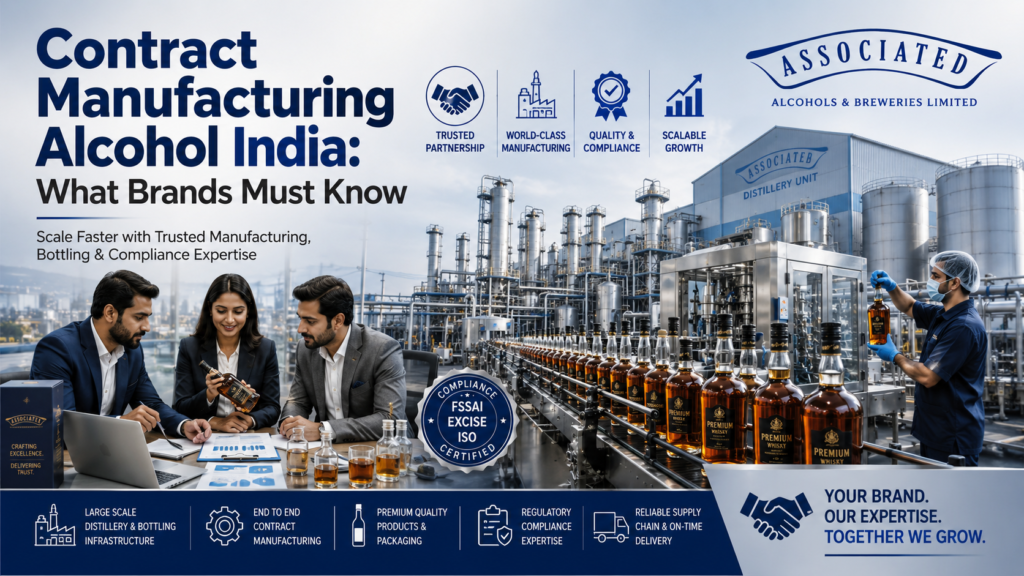
Contract manufacturing in the alcohol industry means a brand owner commissions a licensed distillery or bottling unit to produce spirits under the brand’s label. The brand owner owns the recipe, the label, and the brand registration. The manufacturer handles production, compliance, and sometimes raw material sourcing.
This model separates brand ownership from physical production. It is standard practice across FMCG sectors and is now firmly established in India’s IMFL (Indian Made Foreign Liquor) segment.
How the process typically works
A brand owner finalises the product specification base spirit, blending ratios, flavour profile, and packaging. They then sign a contract manufacturing agreement with a licensed facility. The facility produces, bottles, and labels the product. The brand owner handles distribution and marketing.
The arrangement requires the brand to hold its own label registration and, in most states, a separate brand approval from the state excise department.
Contract manufacturing vs. owned distillery
With an owned distillery, you control production fully but carry fixed costs regardless of demand. With contract manufacturing, costs are variable you pay per case produced. For brands under 10,000 cases per month, contract manufacturing almost always delivers a better unit economics profile.
White-label vs. custom-formulation contracts
Some contract manufacturers offer white-label production you pick from existing recipes and add your label. Others accept custom formulations where you develop the recipe and the manufacturer produces it to spec. Custom formulations typically require a minimum production run and a longer lead time.
How Do You Start an Alcohol Brand in India Without a Distillery?
You can launch an alcohol brand in India without owning a distillery by using a licensed third-party alcohol manufacturer. The core steps are brand registration, label approval, excise licensing (in your target states), and a contract manufacturing agreement with an approved facility.
India’s state excise laws govern alcohol manufacturing and distribution. Each state has its own rules, so the process varies by geography.
Step-by-step launch path
- Incorporate a legal entity and apply for a trade licence.
- Develop your product specification and brand identity.
- Get label registration and brand approval from the relevant state excise authority.
- Sign a contract manufacturing agreement with a licensed facility in the same or a reciprocal state.
- Obtain a bonded warehouse or CSD licence if targeting those distribution channels.
- File for FL-2 or equivalent permits depending on the state.
Which states support contract manufacturing for alcohol?
Madhya Pradesh, Telangana, Maharashtra, Rajasthan, and Haryana are among the more permissive states for third-party alcohol manufacturing. Each state’s excise policy defines whether brands from outside the state can contract-manufacture locally and sell across state lines. MP in particular has built a robust contract manufacturing ecosystem.
What licences are required?
Requirements vary by state but typically include a brand registration certificate, label approval, a manufacturing agreement countersigned by a licensed distillery, and in many states a separate bottling unit approval. Some states also require a security deposit with the excise department before approvals are granted.
What Are the Benefits of Contract Manufacturing for Alcohol Brands?
Contract manufacturing gives alcohol brands speed, flexibility, and lower upfront capital requirements. A brand can go from product concept to first shipment in 6 to 12 months versus 3 to 5 years for a greenfield distillery build. That speed-to-market advantage is significant in a category where shelf space and distributor relationships are competitive.
Key advantages for emerging brands
- Lower capital requirement: no land, construction, or machinery costs.
- Faster market entry: most brands can launch within one financial year.
- Production flexibility: scale up or down based on demand without idle capacity costs.
- Access to established compliance infrastructure: the manufacturer handles most regulatory filings.
- Geographic reach: contract manufacturers in different states enable multi-state launches without separate production investments.
Is contract manufacturing legal for alcohol in India?
Yes, contract manufacturing is legal for alcohol in India under the relevant state excise acts. The model is expressly recognised in the excise policies of several states. The brand owner must still hold valid licences, approvals, and brand registrations. The manufacturer must be a licensed distillery or bottling unit under the state’s excise laws.
For a detailed breakdown of how licensed facilities structure these agreements, this overview of contract manufacturing for alcohol brands covers the operational model in depth.
Risks brands need to manage
Quality consistency is the primary risk. Without direct production control, brands depend entirely on the manufacturer’s processes. Build quality assurance protocols into the contract including batch testing rights, third-party lab audits, and rejection criteria. Also negotiate IP protections for proprietary formulations.
What Is the Cost of Contract Manufacturing Alcohol in India?
Contract manufacturing costs in India vary by spirit type, volume, and facility. As a broad benchmark, whisky production on a contract basis typically runs between INR 80 and INR 150 per 750ml bottle at the manufacturing stage, excluding excise duty, packaging, and logistics. Rum and vodka tend to be at the lower end; premium blended whisky at the higher end.
Cost components to budget for
- Manufacturing fee (per case or per litre of spirit)
- ENA (Extra Neutral Alcohol) or malt spirit cost
- Packaging: bottles, caps, labels, cartons
- Excise duty: varies significantly by state and spirit category
- Freight and logistics from plant to distributor
- Brand approval and label registration fees
- Compliance and quality testing costs
Minimum order quantities
Most licensed contract manufacturers in India set a minimum production run of 500 to 1,000 cases per batch. Some accept smaller pilot runs for new brand launches at a premium per-case cost. Negotiate minimum run clauses carefully they directly affect your working capital requirements.
Conclusion
Contract manufacturing alcohol India is a proven model that gives new brands a viable path to market without the capital burden of owning production infrastructure. The model works because it separates brand-building from manufacturing two very different skill sets that rarely need to live in the same company at the early stage.
The key decisions are state selection, manufacturer vetting, and getting your licence stack right from day one. India’s alcobev market is growing faster than most categories, and the brands that move fast with lean models will capture a disproportionate share of that growth.
As more states update their excise policies to attract investment, contract manufacturing in India’s alcohol industry is likely to become even more accessible. The real question for founders isn’t whether this model works it’s how quickly they can execute it.