
New York businesses are under pressure to do more with fewer resources. According to McKinsey, companies that adopt AI-powered automation see a 20–30% reduction in operational costs within 18 months. An Agentforce implementation partner in New York helps companies deploy autonomous AI agents directly within Salesforce automating tasks across sales, service, and operations without rebuilding existing systems.
This post explains what Agentforce is, how it differs from older automation tools, which industries are adopting it fastest, and what the implementation process looks like.
What Is Agentforce and How Does It Work?
Agentforce is Salesforce’s autonomous AI agent platform. It deploys AI agents that can reason, make decisions, and take action across CRM workflows without a human triggering each step. The agents run within the Salesforce ecosystem and connect to your existing data, objects, and processes.
Unlike traditional bots or rule-based automation, Agentforce agents use large language models (LLMs) to interpret context and respond dynamically. They can handle customer queries, update records, escalate cases, and initiate follow-ups all within a single platform.
The platform includes a no-code builder called Agent Builder, which lets teams define what an agent can do, what data it can access, and when to involve a human. This makes deployment faster than custom AI builds.
How Agentforce Differs from Standard Salesforce Flows
Salesforce Flows are triggered automations they run a fixed sequence of steps when a condition is met. Agentforce agents are goal-driven. You give the agent an objective and it determines the steps to reach it, which changes with each scenario.
What Data Does Agentforce Use?
Agentforce accesses your Salesforce org’s existing data contacts, cases, opportunities, and custom objects. It also integrates with external knowledge bases via Retrieval-Augmented Generation (RAG), so agents can pull from product documentation or internal SOPs when responding to queries.
What Actions Can an Agentforce Agent Take?
Agents can send emails, update records, create tasks, trigger flows, route cases, and communicate with customers via chat or email. The scope of actions is defined during implementation and controlled through permission sets in Salesforce.
How Does Agentforce Differ from Traditional Automation Tools?
Traditional automation tools including RPA platforms and rule-based bots follow scripts. They break when inputs change. Agentforce agents adapt to new information in real time. This is the core difference: rule-based tools automate repetitive steps, while AI agents handle variable, judgment-intensive tasks.
Gartner predicts that by 2026, 30% of enterprise software applications will include embedded AI agents capable of autonomous decision-making, up from under 5% in 2024. For New York enterprises already running Salesforce, Agentforce reduces the cost of adding this capability because it lives inside your existing CRM environment.
Agentforce vs RPA Platforms
RPA tools like UiPath or Automation Anywhere automate UI-level tasks they interact with screens. Agentforce operates at the data and logic layer inside Salesforce. This means fewer brittle integrations, lower maintenance overhead, and faster adaptation when business rules change.
Agentforce vs Salesforce Einstein Bots
Einstein Bots handle defined conversation flows with static decision trees. Agentforce agents use LLMs to understand intent, ask clarifying questions, and take multi-step actions. They are not chatbots they are agents with reasoning capability.
Is Agentforce Suitable for Mid-Market Businesses?
Yes. Agentforce is built on the same Salesforce infrastructure that mid-market companies already use. You do not need a separate AI infrastructure investment. The main requirement is a well-structured Salesforce org with clean data. Most mid-market New York companies working with a qualified implementation partner can go live with a first agent within 6–10 weeks.
What Industries Benefit Most from Agentforce in New York?
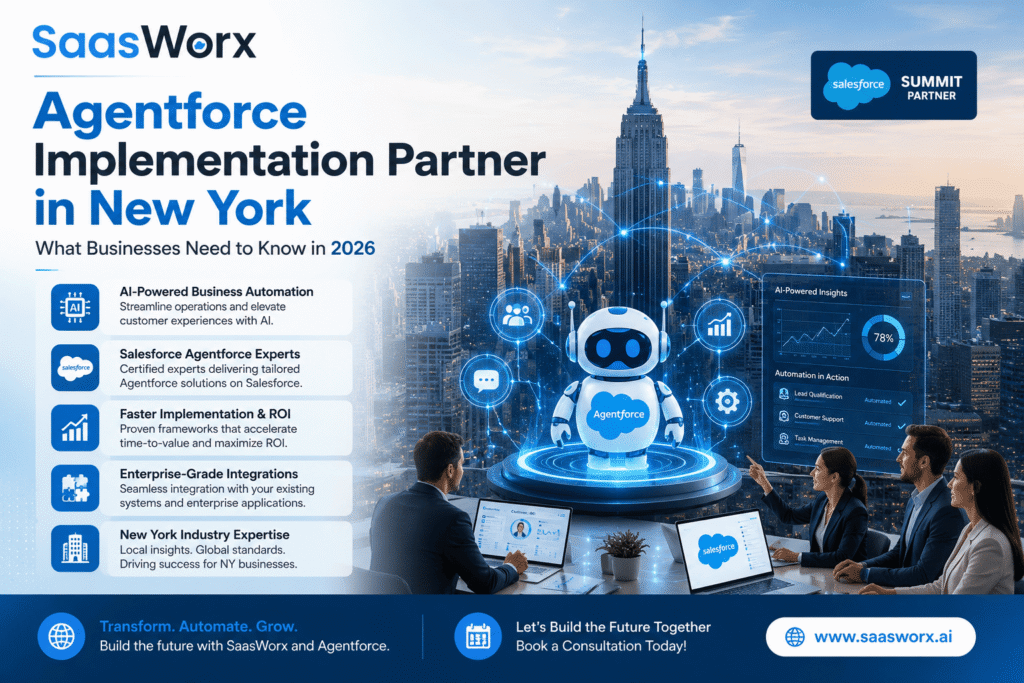
Financial services, professional services, healthcare tech, and SaaS companies in New York are seeing the fastest adoption. These sectors handle high volumes of client interactions, have complex case management requirements, and run on Salesforce already making Agentforce a natural extension.
A Forrester study found that companies in financial services and professional services that deploy AI agents in customer service reduce average handle time by 40% and increase first-contact resolution by 25%.
Agentforce for Financial Services Firms in NYC
Wealth management, insurance, and lending firms use Agentforce to handle client onboarding queries, policy questions, and account updates. Agents pull from Salesforce Financial Services Cloud and can escalate to human advisors when regulatory or sensitive issues arise.
Agentforce for SaaS and Tech Companies
SaaS companies use Agentforce to automate tier-1 customer support, trial onboarding, and renewal outreach. An agent can identify an at-risk account based on usage data, draft a personalised outreach message, and create a task for the account manager all without human initiation.
Agentforce for Professional Services Firms
Consulting and legal service firms use Agentforce to manage intake, scheduling, and status update communication. Agents handle the routine back-and-forth that consumes associate and coordinator time, freeing staff for higher-value work.
What Does an Agentforce Implementation Partner Do?
An Agentforce implementation partner in New York designs, configures, and deploys AI agents within your Salesforce environment. They assess your existing org structure, define agent scope and use cases, build the agent configuration in Agent Builder, and connect it to your data sources and action sets.
A partner also manages testing, runs user acceptance cycles, and trains your team on monitoring and managing agents post-launch. This is where working with an experienced team matters poorly scoped agents or insufficient testing leads to agents taking unintended actions on live records.
What to Look for in an Agentforce Partner
Look for a partner with active Salesforce certifications, prior Agentforce deployment experience, and knowledge of your industry’s compliance requirements. In New York, this matters especially in financial services and healthcare, where data handling rules are strict.
For businesses evaluating options, this guide to working with an
For businesses evaluating options, this resource on Agentforce consulting for US companies provides a useful framework for scoping your first deployment.
How Long Does an Agentforce Implementation Take?
A focused, single-use-case implementation typically takes 6–10 weeks. This includes a 2-week discovery and scoping phase, 3–4 weeks of build and configuration, and 1–2 weeks of testing and training. Multi-agent or enterprise-scale deployments take 3–6 months depending on org complexity and data readiness.
What Does Agentforce Implementation Cost?
Costs vary based on scope, number of agents, and integration complexity. Most New York mid-market implementations range from $25,000 to $80,000 for a partner-led engagement. This excludes Salesforce licensing. Enterprise deployments with multiple agents and deep integrations can exceed $150,000.
Conclusion
Agentforce gives New York businesses a practical path to AI-powered automation inside the Salesforce platform they already use. The key is scoping the right use cases first and working with an implementation partner who understands both the technology and your industry context. As AI agents move from early adopters to standard enterprise infrastructure, the question for most businesses is not whether to implement it is which process to start with.