
Businesses in Ajman that work with a certified NetSuite ERP partner complete implementations 40% faster and report higher user adoption than those who go direct. A local partner provides the on-the-ground knowledge, UAE compliance expertise, and post-go-live support that a global vendor cannot. This post covers what a NetSuite ERP partner in Ajman actually does, which industries benefit most, and how to evaluate your options before signing a contract.
What Does a NetSuite ERP Partner Do in Ajman?
A NetSuite ERP partner in Ajman handles the full implementation lifecycle from requirements mapping and system configuration to data migration, user training, and ongoing support. They translate your business processes into NetSuite workflows and ensure the system aligns with UAE-specific requirements like VAT filing, WPS payroll, and multi-currency reporting. Without this local layer, most SMEs struggle to get the system working the way their operations actually run.
Implementation vs. Reselling: Know the Difference
A reseller sells NetSuite licences. An implementation partner sells licences and delivers the technical and functional work to make the system live. In Ajman, you need a partner not just a reseller because the implementation quality directly determines your ROI. Partners certified under Oracle’s SuiteSuccess methodology follow a structured deployment model that reduces go-live risk and shortens timelines.
What Local Expertise Actually Covers
Local expertise means the partner understands Ajman Free Zone regulations, Arabic language requirements for documents, UAE Federal Tax Authority (FTA) VAT return formats, and Wages Protection System (WPS) integration. These are non-negotiable for any business operating legally in the UAE. A partner without this knowledge will create compliance gaps that cost more to fix than the original implementation.
Ongoing Support After Go-Live
Implementation is only the start. After go-live, businesses need a partner who can handle module upgrades, custom report builds, third-party integrations, and user troubleshooting. The best NetSuite partners in Ajman offer structured support contracts with defined SLAs, not ad hoc email chains. This matters most in the first six months, when user queries spike and process gaps surface.
Why Do Ajman Businesses Need a Local NetSuite Partner?
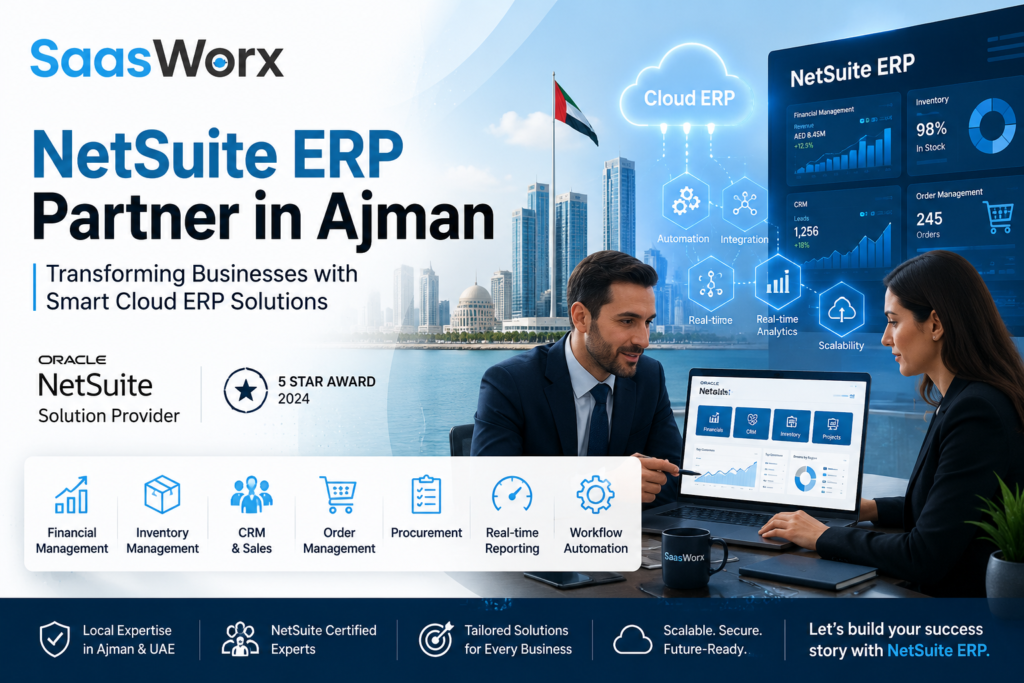
Ajman businesses need a local NetSuite partner because remote implementation fails to account for UAE-specific compliance, Arabic documentation requirements, and the operational norms of free zone and mainland trading. Companies that rely on offshore support teams report longer resolution times, more customisation gaps, and lower ERP adoption rates among staff. A partner based in or near Ajman closes these gaps from day one.
Free Zone and Mainland Compliance
Ajman hosts both free zone companies under Ajman Free Zone Authority (AFZA) and mainland businesses under the Ajman Department of Economic Development. Each has different licensing, audit, and reporting obligations. A local NetSuite partner maps these requirements into the system during setup — not as an afterthought. This includes configuring chart of accounts to match FTA audit requirements and enabling multi-entity consolidation for businesses with both mainland and free zone entities.
Arabic Language and Localisation Requirements
UAE commercial law requires certain documents invoices, purchase orders, payroll records to support Arabic language output. NetSuite supports Arabic localisation, but enabling and testing it correctly requires a partner with hands-on experience. Businesses that skip this step often face issues during FTA audits or when dealing with government entities. For a detailed breakdown of ERP implementation approaches for UAE businesses, this resource on
For a detailed breakdown of ERP implementation approaches for UAE businesses, this resource on NetSuite ERP implementation in Ajman covers the local compliance and module configuration considerations in depth.
Time Zone and Response Time
Working with a partner in the UAE means issues get resolved during your business hours. ERP problems failed payroll runs, broken integrations, incorrect VAT submissions cannot wait 12 hours for a response from a different time zone. Local partners typically offer same-day support for critical issues, which directly reduces business disruption.
What Industries Benefit Most From NetSuite ERP in Ajman?
Manufacturing, wholesale trade, and logistics businesses in Ajman see the strongest returns from NetSuite ERP implementation. These sectors deal with multi-location inventory, supplier management, production costing, and complex revenue recognition all areas where NetSuite’s core modules outperform standalone accounting software. According to Gartner, midsize manufacturers that implement cloud ERP cut month-end close time by an average of 25% within 12 months of go-live.
Manufacturing and Assembly
Ajman has a growing manufacturing base particularly in food processing, aluminium fabrication, and light industry. These businesses need production planning, bill of materials management, and real-time cost tracking. NetSuite’s Manufacturing module, configured by an experienced partner, connects shop floor operations to financial reporting without requiring manual data entry or spreadsheet reconciliation.
Wholesale and Distribution
Wholesale trading companies in Ajman often manage hundreds of SKUs across multiple warehouses and customers in different Emirates. NetSuite’s inventory and order management capabilities handle this natively. The critical factor is how the system is configured lot tracking, landed cost allocation, and multi-warehouse transfer logic all require partner expertise to set up correctly.
Professional Services and Consulting
Service businesses IT firms, engineering consultancies, staffing agencies use NetSuite primarily for project accounting, billing, and revenue recognition. In the UAE, where project-based work often spans multiple entities and currencies, NetSuite’s multi-book accounting gives CFOs a single view of financials. A partner who has delivered professional services implementations in the UAE will configure this correctly from the start.
How to Evaluate a NetSuite ERP Partner in Ajman
To evaluate a NetSuite ERP partner in Ajman, check their Oracle certification tier, the number of live NetSuite customers they support in the UAE, their familiarity with your specific industry, and their post-implementation support model. Certification tiers Registered, Star, and Five-Star reflect both technical competency and customer satisfaction scores validated by Oracle. A partner at Star level or above has completed multiple successful implementations and passed Oracle’s audit process.
Questions to Ask Before Signing
- How many NetSuite go-lives have you completed in the UAE in the past 24 months?
- Do you have certified consultants for the specific modules we need manufacturing, WMS, or PSA?
- What does your support contract cover, and what is your average response time for critical issues?
- Can you provide references from businesses in Ajman or the Northern Emirates?
- How do you handle UAE VAT configuration and FTA audit readiness?
Red Flags to Watch
- Partners who quote fixed implementation timelines without a discovery phase
- Offshore teams with no UAE-based project manager
- No formal SLA for post-go-live support
- Inability to demonstrate Arabic localisation in a live environment
- Pricing that excludes data migration, training, or customisation from the base quote
Conclusion
Choosing a NetSuite ERP partner in Ajman is not just a technology decision it is a business risk decision. The right partner reduces implementation time, ensures UAE compliance from day one, and builds a system your team will actually use. As Ajman’s economy continues to diversify and SMEs face pressure to compete with larger regional players, the quality of ERP implementation will increasingly separate businesses that scale from those that stall. The real question is not whether to implement NetSuite it is whether your partner has the depth to do it right.